Showing posts with label criterion. Show all posts

Saturday, October 16, 2010

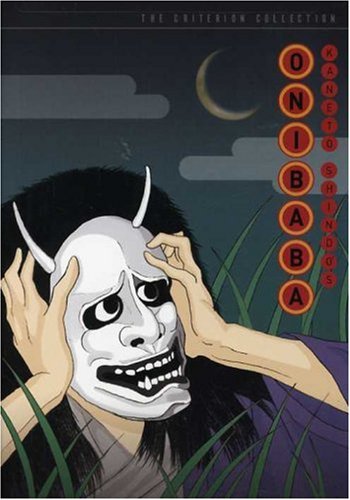
The Red Eye Report's 2010 October Horrorthon #16: "Onibaba"


Japan's "Warring States" period was not a good time to be a peasant. Civil war left the country in ruins, its two highest courts were at each other's throats, and, as always, the lower class paid the price. In a house stationed amidst a vast susuki field live the mother (Nobuko Otowa) and wife (Jitsuko Yoshimura) of a farmer who was called off to battle. It's just been the two of them for a while, squeezing out a living by ambushing the occasional samurai and selling off whatever belongings they can. But out of the blue one day comes Hachi (Kei Sato), a neighbor who finally fled from the bloodshed. Slowly, he integrates himself into the womens' self-enclosed world, spurning the mother's advances while enjoying some splendor in the grass with her daughter-in-law. Emotions are mounting as is, but when a wandering warrior with a demonic mask pays the trio a visit, all of the brewing treachery and betrayal comes to a terrifying boil.


One man, two women, an isolated setting, the air thick with sexual tension -- you'd swear Onibaba was written by Tennessee Williams after a sake bender. But Kaneto Shindo's 1964 picture draws its inspiration from a Buddhist parable, which is enough of an indication that this flick will be playing old-school. Onibaba isn't very steeped in the supernatural (as unlikely as certain scenarios are, they do have basis in reality), but karmic overtones are liberally dispersed throughout. Shindo shows some very bad people doing very bad things, but it's how he goes about displaying his morality that makes the story so fascinating. This isn't so much a battle between good and evil as it one between two different evils -- the farmer's mother doesn't want to lose her partner in crime, and Hachi is just a horny bastard, and in spite of all this, the daughter still grows herself a conscience. It's fair to say Onibaba doesn't sound interesting if a bunch of bickering louts is all we get, but Shindo has us covered by adding a distinctive visual sweep to an otherwise simple story.


While there are several sections in which very little action takes place, Onibaba always has something planned to keep viewers absorbed. The opening scene, which contains no dialogue and lasts around ten minutes, follows two unfortunate samurai who stumble through the susuki reeds and discover the true extent of the dangers war hath wrought. The unknown does present itself when the mother uses her daughter-in-law's fear of religion to scare her away from Hachi, which brings the film's Buddhist origins (not to mention that funky cover art) full circle. These interactions really make the film, thanks in great part to a hell of an on-target ensemble. Otowa projects a hint of innocence (after all, it wasn't her character's first choice to blindside samurai for a living) while she embodies the perfect manipulative spirit. Meanwhile, Sato taps into his inner Toshiro Mifune to play a scoundrel who couldn't be more pleased to be one, and though Yoshimura has a tough time being noticed, she still holds her own and walks away with a solid performance as the closest thing we have to a "good guy."


A bit slow-going at times, Onibaba more than compensates for it with a tale whose emotions draw in your psyche and keep it locked on the action. Emphasis is on art over keeping the plot occupied, but it's to Shindo's credit that he involves you in the proceedings with a minimum of story and many sections that do without spoken words period. The Criterion Collection did well in admitting entrance to Onibaba, a tale whose terrors are no one's fault but our own souls.

Thursday, October 7, 2010

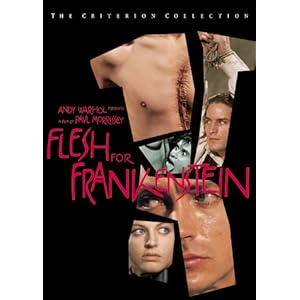
The Red Eye Report's 2010 October Horrorthon #7: "Flesh for Frankenstein"


Baron Frankenstein (Udo Kier) views the world as a five-year-old would an ant farm. Within the bowels of a secluded mansion, he obsesses over purifying the human race and creating life as he sees fit -- by way, naturally, of stitching together only the finest body parts. As our story begins, the Baron has chosen a farmhand (Srdjan Zelenovic) to provide the head topping the culmination of his life's work. Unfortunately, he's missing the sex drive required to propogate the Baron's master race with a female creation he also has stashed away. That belongs to a local stableboy (Joe Dallesandro), who's currently using his gift to service the frigid Baroness Frankenstein (Monique van Vooren). But after the servant discovers what happened to his friend, he sets out to railroad the Baron's experiments and end his madness for good.

You have to wonder what frame of mind was used in making Flesh for Frankenstein. Considering Andy Warhol's involvement (which was reportedly very thin), being confused could just as well be the point, but this intensely sexualised take on a classic horror story has an agenda that rings quite clearly. The film is on a mission to challenge you, and challenge it does, reminding viewers of the true terrors of a tale that had at the time been rendered innocuous by kiddie monster shows. In fact, Flesh for Frankenstein could have the strongest moral code of any Frankenstein adaptation. While so many other versions inevitably cast their doctors as erstwhile noble men falling under the spell of scientific progress, Kier's Baron is a bastard to the bitter end. Blunt and open about his desire for racial purity, the Baron not only gave into insanity long ago but couldn't care less who knows it.

Yet as Wikipedia is so kind to include in its summary, Flesh for Frankenstein pays as much stylish tribute to the mad scientist classics as it satirizes and sensationalizes them to the extreme. The decaying laboratory, the various apparatuses, monologuing about life and death every three minutes -- there's enough common ground for monster fans to get comfy before being plunged into a psychosexual clustercuss. But the flick's on-the-fly approach does have its drawbacks, namely in the acting (or lack of acting) department. Although we know and love Udo Kier as the cult icon he is today, you can tell this is one of his first big gigs, so don't be surprised to catch a whiff of Tommy Wiseau in his performance. But he's still bugnuts crazy enough to let pass, as opposed to Dallesandro's wooden American accent leaving his scenes with the profundity of a cabbage belch.

Notorious for a reason and not for the faint of heart (or those who value joy in the world), Flesh for Frankenstein is rough around the edges but undeniably fascinating. Even if Warhol didn't have much to do with the production, his presence is there, persisting in writer/director Paul Morrissey's quest to show audiences what true horror is. Driven equally by ideas and exploitation, Flesh for Frankenstein is one tawdry little creation with plenty of life in it.

Friday, October 16, 2009

October Horror-thon #16: "Corridors of Blood" (1958)


Pain and the knife are inseparable...

Such was the attitude of most medical professionals in 1840s England, at least according to Corridors of Blood. It was a time before anesthesia was introduced, when operations had to be performed quickly to avoid prolonging a patient's pain. But this approach doesn't sit well with Dr. Thomas Bolton (Boris Karloff), one of the country's top surgeons. Sickened by the cries of horror he hears on a daily basis, he decides to formulate a gas to numb one's senses. Bolton successfully creates a batch, only to develop an unfortunate addiction to the stuff. His experiments proceed to consume his life and destroy his career, to the point that he pairs up with a cryptic criminal (Christopher Lee) to perfect his concoction.

The way it usually went in cinema's golden age was that if you hit it big in horror, that's where you stayed. It's easier for genre actors to branch out these days, but you need only survey the careers of Karloff or Bela Lugosi to witness the side effects of being typecast. But bless his heart, Karloff made the best of it by delivering performances so uncommonly good, he was almost always the highlight of his vehicles. Corridors of Blood is no different, though it has the added bonus of a sound story to start with. It's more of a historical thriller than a fright fest, its disposition leaning more towards tragedy than delivering shocks. In fact, it's not unlike Karloff's own The Body Snatcher, in which roles are reversed, and Karloff brilliantly played a villain who specializes in conjuring corpses.

And just as with The Body Snatcher, Karloff really is the heart of this film. He's a man you can't take your eyes off of, whom you can't help but feel sorry for as good intentions lead him down a dark road (a theme repeated by countless misguided movie scientists of the time). The terrible lengths to which Bolton will go in the name of a noble cause generate more suspense than any traditionally lurid thrills. That said, director Robert Day really nails the film's mood, with just a few simple sets and a colorful population of supporting players. Lee stands out in particular, and it's no wonder why; he was just getting into Hammer's Dracula pictures at the time, and even in his low-key role here, he displays a chilling presence that the man still hasn't been able to shake.

Corridors of Blood does run out of things to do when the third act commences. It would've been better having taken a cue from some of Karloff's Universal outings, which ran a little more than 60 minutes and ended just when the dramatic payoff was at its most ripe. But Corridors of Blood still runs smoothly a great deal of the time, thanks in no small part to Karloff. The film is proof positive that not only was he a great horror actor, he was a terrific performer all-around, possessing the pathos to transform a simple tale of terror into a much more involving picture than it could've been.