Showing posts with label asia extreme. Show all posts

Wednesday, October 13, 2010

The Red Eye Report's 2010 October Horrorthon #13: "The Last Supper" (2005)


If plastic surgeons were rock stars, Dr. Yuji Kotorida (Masaya Kato) would be at least an Allman brother. A man whose surgical prowess has earned him the nickname of "God-Hand," the doc has made out well for someone who started out as a meek med student. But little does a visiting TV crew know about the true secret behind his good fortune: old-fashioned cannibalism. One bag of fat stolen on impulse kick-started Dr. Yuji's hunger, and from then on, his appetite for the human body grew and grew. Conveniently, Yuji has chronicled his history on an anonymous blog, which he kindly narrates for the viewers at home. From finding his first full meal to attending an underground dinner in Hong Kong, Yuji details how dining on nubile young women has changed his world for the better -- a lifestyle that, with the arrival of a curious cop, is about to become much harder to maintain.


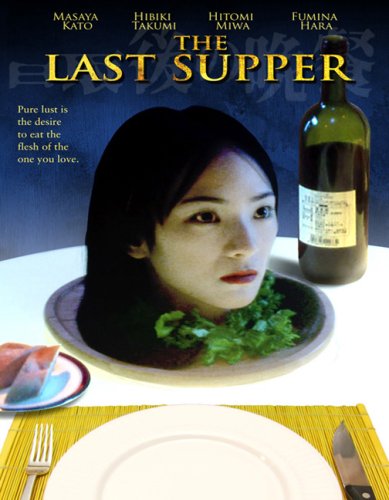
Y'know, The Last Supper is guilty of many things, but false advertising isn't one of them. Twenty minutes in, and that noggin on the cover is staring right back at Yuji as he munches on what was probably her favorite thumb. Just reading the premise had images of The Untold Story dancing in my head, but while it is about as gruesome, The Last Supper lacks the right sense of humor, arresting performances, or anything that might help make it a halfway enjoyable experience. Long story short, the flick is a total bore, and it's a lazy one at that. You might not think that of something that serves up the flesh-eating equivalent of Eyes Wide Shut's orgy scene, but it's incredible how remarkably dull such an odd premise has been rendered. The Last Supper mainly consists of Dr. Yuji narrating blog entries, and what do his reasons for turning to cannibalism amount to? "Because." But don't worry, there's some gratuitous religious imagery that helps give the story a first-class seat on the Pretension Express.


Yuji just isn't that fascinating of a character, neither as anti-hero or target of satire, which he easily could've been. A guy paid to carve up women takes his job to the extreme when he's off-duty? The Last Supper could've ripped the likes of Dr. 90210 a new one, but instead, it pulls the character study card, which, in this case, means Yuji moping around and giving hollow excuses as to why Mrs. Yoshita is missing a torso. Kato's performance isn't the worst, but he definitely needs a charisma transfusion, and between those consumed by Yuji and those who appear whenever they damn well please, it's not worth getting attached to the supporting cast either. Not even the gore scenes provide any satisfaction, as you're either too grossed out by organs being flat-out shoved at the camea or laughing too hard at the many amusingly fake decapitations.


Don't be fooled by the lurid cover; The Last Supper is just another feckless attempt to cash in on horror buffs in search of the next big shock. Japanese hottie on a bed of lettuce aside, it's a pretty boring affair, not diabolical enough to make the gore fly or intelligent enough for what it calls "observations" to hold any water. Maybe this is a sign of how jaded a genre fan I've become, but The Last Supper goes to show that if you've seen one cannibal chef on the loose, you've sure as hell seen 'em all.

Monday, October 11, 2010

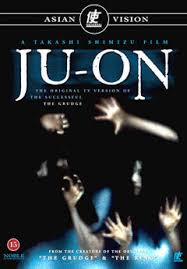
The Red Eye Report's 2010 October Horrorthon #11: "Ju-On: The Curse"


Before Sony saw fit to give him a budget, Takashi Shimizu cut his teeth in the world of shot-on-video with Ju-On: The Curse. A prototype of his J-horror hit-to-be, this Ju-On also centers on a house that's been damned to the nth degree. A tragic event took place there some time ago, leaving behind a festering evil that claims the lives of those who dwell within its walls. As with the others in the series, the seemingly harmless abode's story is chronicled through nonlinear vignettes, ranging from three to ten minutes in length and focusing on one particular soul that comes in contact with the house. From a concerned teacher to a worried girlfriend, many fall prey to the wrath a croaking spirit that comes to scare them into an early grave. But when the curse finds its way to a frightened real estate agent, she resolves to warn potential buyers of the two stories of terror that await them.

I like to think that Takashi Shimizu is a smart guy. His work impressed and scared the hell out of Sam Raimi, who brought him to the attention of stateside horror fans and kept the Asia shock boom truckin' in The Ring's wake. Shimizu knows what's expected of him and delivers nothing less, which is why the idealist inside me wants to believe that he made six Ju-On features (counting The Grudge and its first sequel) to prove how much the premise just doesn't work. There's no other way to explain why anyone rational would regurgitate entire characters and story threads so many times, when it's been made clear that everyone in these flicks is boned from the word go (turns out there's not much suspense in nihilist horror stories). Maybe Ju-On is meant to be enjoyed in fragments; take a random frame from any ghost sequence, find the right sound effect, and boom, you have Internet screamer gold. But trying to follow an actual story or sympathize with anyone not currently undead here is as worthwhile as watching a Ringu print that's being fed through a woodchipper.

Speaking of choppy structures, let's talk about the one Ju-On: The Curse has to share with the class. To Shimizu's credit, it works better here than in some of his other movies, but it still reeks of cheating to have the turn of events jumbled around for the sake of Shimizu feeling good about bamboozling you in the easiest way possible. Plus, for a film built on the element of surprise and ghosts that appear out of nowhere, nothing really shocks you here. Even forgetting that its fellow Ju-Ons exist, you know exactly what will come to pass here (that its climactic plot twist is telegraphed by the freaking opening title card is kind of a downer, as well). Hell, I thought being video-based would help Shimizu here, since it added a lot to the film's flawed but intermittently spooky comrade Ju-Rei: The Uncanny, but no dice. The effects are crummy, the dramatic zooms are hilarious, and let's say it's not all that horrible that actors this stiff don't last long onscreen.

I want to say I read somewhere that much of Japanese cinema is based on a foundation of emotion over storytelling perfection. The ultimate goal gets more attention than the journey there, which I can totally see going on with Ju-On: The Curse. When all's said and done, it'll freak out its share of folks, but if 70 minutes of near-silence and household busywork are the best it can serve up along the way, you're better off having a grand old time doing your own damned chores.

Sunday, October 10, 2010

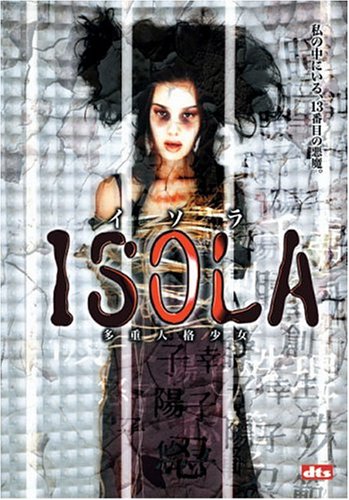
The Red Eye Report's 2010 October Horrorthon #10: "Isola"


In the wake of a 1995 earthquake that rocked central Japan, Yukari (Yoshino Kimura) has come all the way from Tokyo to pitch in with the clean-up. Once there, she learns that she has the ability to read the minds of others and starts using it to help relieve their various traumas. But one girl Yukari encounters proves to be quite the enigma: Chihiro (Yu Kurosawa), who seems to be a perfectly average high schooler. The reality is that she possesses thirteen different personalities, including a suicidal junkie and a five-year-old reliving a car accident. But the most dangerous personality of all is Isola, a wraith who can actually cause harm to those who antagonize Chihiro. Still trying to get a grip on her own abilities, Yukari sets out to uncover Isola's origins and stop her from hurting Chihiro or those around her.


Films ask their viewers to accept the impossible on a constant basis, but in a few cases, the demands can seriously pile up. Not only does Isola ask the world of you, it unloads everything it has in one sluggish, eye-rolling load without even waiting for an answer. Not only that, but it's very flippant towards itself, casually acknowledging elements and events that would barely fly in Hideo Nakata movies. There's a lot to go through here, what with Yukari's psychic powers, Chihiro's multiple personalities, and science experiments that kinda, sorta attempt to tie the fine mess together. But nothing comes close to gelling, and that's mostly because Isola hasn't a hint of logic to its name. I'm all for flicks tapping into their bizarre sides (hell, that's pretty much why I have a Netflix account), but there has to be some structure for me to accept any of this without the words "Pabst," "Blue," and "Ribbon" being involved.


Take, for instance, Yukari. She's a bit of a wild card, since we see her have the occasional freak-out in between popping antipsychotics throughout the film. Fair enough, and at the beginning, she seems surprised that she can hear what those around her are thinking, but towards the end, she gives the impression that she's been living as a psychic for some time. Then there's Chihiro, who the movie goes out of its way to say has thirteen personalities. Even the film's technical subtitle is Persona 13, but the most we ever get to know are three or four, and that's including Isola. On top of that, if Chihiro is so troubled to begin with, why isn't she being cared for professionally? Sure, she has an adoptive father who couldn't care less about her, but when Yukari proposes medicating Chihiro later on, she acts like it's the breakthrough of the century. There's no consistency whatsoever, just plot twists that duck their heads in because the drama of the moment dictates that something happen.


I didn't mean for this review to turn into a total bitchfest, but one of my benchmarks for a bad movie is that I think more about the nagging details than I end up enjoying the action. I dug some aspects of Isola, especially Kurosawa's sympathetic acting and a creepy look that you'd swear didn't belong to a ten-year-old flick. But as Isola demonstrates in the latter's favor, there's a big difference between a thriller that grabs you by the balls and one that pounds them into baking soda.

Friday, October 8, 2010

The Red Eye Report's 2010 October Horrorthon #8: "Goth"


On a sunny, nondescript day, a woman's body is found propped up in a public park and her left hand completely severed. As another corpse was found in a similar state months prior, the police ponder the possibility of a serial killer, though they're not the only ones following the case. A fascination with all things morbid has brought together two teenagers from otherwise different background: Morino (Rin Takanashi), who's since given into her outcast status, and Kamiyama (Kanata Hongo), a cheery kid who harbors a secret obsession with death. Once they catch wind of the murders, the teens team up to track down the culprit and uncover his true motives. But when they stumble upon the killer's own journal, Morino and Kamiyama are forced to choose between going to the authorities or risk allowing potential deaths for the sake of understanding their own wounded psyches.


As in real life, it's hard to distinguish true adolescent angst from abject whining. But Goth isn't here to dissect subcultures; it's just a moody mystery, which is all jake with me. Hell, it doesn't even seem overtly mopey -- until you realize it's precisely that, just not from an aural standpoint. As Goth's characters suffer in silence, so does the viewer, who bears witness to a 96-minute pout-off that probably could've taken half an hour if its leads got the anchors out of their pants. This movie buys its dramatic pauses from the same Sam's Club as the Twilight franchise, and it's even more cavalier about using them to create the illusion that, no really, we're totally sad, you guys. There's feeling numb towards the world, and then there's catatonia, and from how blase Morino and Kamiyama react to the horrors they encounter, one wonders behind what plants their life support machines are tucked.


But as much as I'd love to fully condemn Goth as emo twaddle, here's where I have to pump the brakes. I hate to say it, but Goth isn't altogether uninteresting; the false emotions stem more from a director who's allergic to editing than from a flawed story. There are times when the plot is quite absorbing and not prone to beating us over the head as high school melodramas have before. For the most part, the sadness Morino and Kamiyama feel is genuine; it never seems like a vapid call for attention, and in Morino's case, it's even a form of penance. Kamiyama isn't as well-defined, but I dig the idea of a social butterfly hiding his dark side with disturbing ease. But again, their nonchalant nature returns to bite them in the aft end, sapping all the oomph from erstwhile challenging scenes, such as when Morino dresses as a murder victim to feel the sensation of being stalked. The climax is its own beast, one that bum-rushes story threads it should be resolving and prolonging ones that beg for the Old Yeller treatment.


A few years back, the Pang Brothers, those masters of inconsistency, made a minor masterpiece about dwelling on death. The film is called Ab-Normal Beauty, and it's a lurid, seedy, and whip-smart riff on everything Goth tries to do. Respectable as the filmmakers are towards characters often thrown to the stereotype wolves, real insight is in short supply, while the greatest terror comes from realizing you put money towards something scraped off the side of J-horror's aquarium.

Saturday, October 17, 2009

October Horror-thon #17: "The Butcher" (2009)


One of South Korea's most grisly exports, The Butcher wastes no time in getting right to the carnage. The picture concerns a quartet of unfortunate souls bound and gagged in an abandoned warehouse. They find themselves unwilling participants in the ultimate horror show, a snuff film starring a chainsaw-wielding psycho wearing a pig's head. After two fellow victims bite the dust, a husband and wife are next led to the slaughter, where the former is forced to choose between saving his spouse or his own skin. In the meantime, the film shifts between different cameras, one handled by a demented director and the other strapped to the husband's head, chronicling every grueling moment for the sake of some sicko's jollies.

I doubt those behind The Butcher knew how prophetic their inaugural image of a guy whizzing on a wall would be. After all, you spend the entire film witnessing what could have been a truly visceral experience letting potential run down its leg. The Butcher is the result of a current movement's efforts to bring horror back to basics, to focus on overall effect rather than heedless frills. It's a good idea on paper, but when director Kim Jin-won abandons all pretenses, he's left with a lot of wailing and bloodletting, with nothing to show for it but some sore throats and stained clothes.

Here is a film that might have been saved were it a satirical Trojan horse, condemning shock cinema by way of a work that appears to celebrate it. But if The Butcher possessed such ulterior motives, they were drowned out by Mr. Motel Hell up there and his peacemaker. I'll concede that the flick was effective at times, especially early on, when viewers have nothing but the distant roar of a chainsaw to base their fears on. The simple approach may be exactly what some fans are looking for, but color me crazy, I wanted more. I need a reason to invest myself in characters who go to hell and back other than them just being in the horrible situation they are. Otherwise, it gets dull watching the flick try to push your buttons and not care how disgusting it becomes in doing so.

Buyer beware, for The Butcher is a very intense flick. Even in the wake of Hostel and the Saw saga, there's some mighty disturbing imagery here. But beyond the nauseating effects work, The Butcher is a journey into boredom, complimented by more gratuitous cursing than a Rob Zombie movie. The flick represents Tartan Films' return to the Asia Extreme scene, but you're likely to find more fulfilling frights elsewhere in their library.